What Are the Top Stages of the Bone Healing Process?
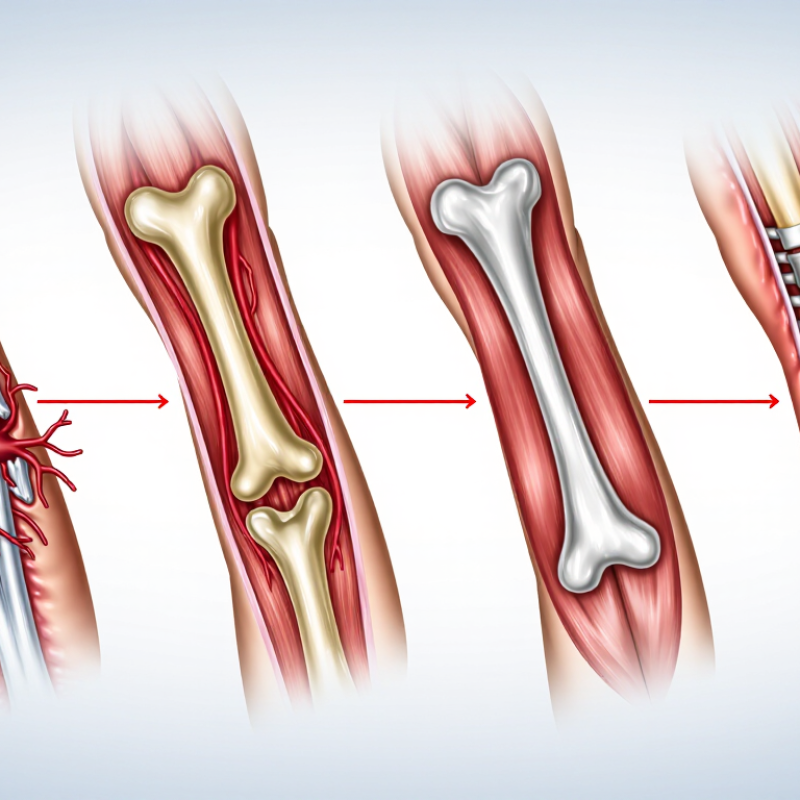
A fracture may look still from the outside, but repair is active beneath the skin. The bone healing process unfolds through connected stages, each shaped by the injury, blood supply, and a person’s overall health. It starts with inflammation: damaged small blood vessels form a clot around the break, creating a temporary framework for repair. Swelling and tenderness are common. They are part of the body’s response, though their severity can vary.
Next, repair cells build a soft callus that bridges the fracture. Think of it as a flexible patch, not finished bone. Over time, the body replaces this tissue with a harder callus, strengthening the connection. Later, remodeling gradually reshapes new bone, adapting it to the stresses of daily movement. These stages are useful to understand, but they do not always follow a neat calendar. Healing can take weeks or months, depending on the fracture and individual factors.
The sections that follow explore each stage, what is happening inside the bone, and how clinicians assess progress. Imaging may show changes before a person feels fully recovered, and comfort alone cannot confirm that a fracture has healed. That distinction matters. A diagram makes the process look orderly; real recovery can be uneven, and sometimes slower than expected. This overview is educational, not a substitute for guidance from a healthcare professional familiar with the specific injury.
Hematoma Forms Within Hours, Triggering the Initial Inflammatory Response
Within minutes to hours after a bone breaks, small blood vessels tear and blood collects around the fracture. This pocket of blood is called a hematoma. It may contribute to swelling and tenderness near the injury.
The clot provides a temporary framework, while platelets and damaged cells release signals that attract immune cells. These cells clear debris and begin an inflammatory response that helps coordinate repair. Mild warmth, swelling, and soreness can occur, but symptoms alone cannot confirm how well a fracture is healing. This is expected. The biology is orderly on paper; actual injuries vary.
Inflammation is a useful early phase, not a sign that the bone has already joined. The hematoma gradually changes as repair tissue develops, and the timing differs with fracture type, blood supply, and overall health. Avoid treating visible swelling as a reliable measure of healing. A clinician can assess the injury and follow its progress, especially if pain or swelling worsens, or the limb becomes numb or unusually pale.
Inflammatory Cells Clear Damage During the First Several Days
After a fracture, tiny blood vessels break and blood collects around the damaged bone. Within hours, immune cells enter this clot-like hematoma. Neutrophils arrive early; macrophages follow, clearing damaged tissue and releasing signals that recruit repair cells. That cleanup is active work. A review in Nature Reviews Rheumatology describes this inflammatory response as beginning immediately and continuing through the first several days (Einhorn and Gerstenfeld, 2015). A clinical review in Injury also identifies the hematoma and inflammatory-cell activity as early steps in fracture repair (Marsell and Einhorn, 2011).
At the fracture site, swelling, warmth, and tenderness can accompany this response. They do not, by themselves, show whether the bone is healing well. The inflammatory signals help prepare the area for a soft callus, the early tissue bridge that forms later. Timing varies with fracture type, blood supply, and a person’s health; neat diagrams make these stages look more separate than they are. That’s worth remembering. Early symptoms cannot reliably reveal what immune cells are doing beneath the skin. Clinicians assess the whole picture, including the injury, symptoms, and imaging, rather than treating inflammation alone as a healing score.
A Soft Callus Begins Bridging the Fracture Within 2–3 Weeks
After a fracture, the body forms a soft callus as part of its repair process. In many fractures, this flexible bridge begins developing within about two to three weeks. Timing varies. The injury’s location, severity, blood supply, age, and overall health can all affect healing. The callus is made mainly of fibrous tissue and cartilage, linking the broken bone ends while new bone forms.
Not solid bone yet. The soft bridge is less rigid than the bone it will become, so pain or swelling may still occur. A person may feel better before the fracture can safely bear normal loads. Follow the treating clinician’s advice about movement, weight-bearing, and follow-up imaging; symptoms alone cannot confirm that a fracture has healed. X-rays may show changes at different times, and some fractures need longer than expected. It is tempting to treat the two-to-three-week estimate as a deadline, but it is only a typical range, not a guarantee.
What Are the Top Stages of the Bone Healing Process?
A soft callus begins bridging the fracture within about 2–3 weeks.
The stages overlap, and healing time varies with the fracture and the individual. Remodeling can continue for months or years; the chart shows its first year.
Woven Bone Strengthens the Callus as Union Commonly Takes 6–12 Weeks
After a fracture, the body first forms a soft callus around the broken ends. Over the following weeks, bone-forming cells gradually replace parts of this flexible bridge with woven bone. This early bone is laid down quickly, with fibers arranged less neatly than in mature bone. Even so, it adds strength and helps connect the fracture site. The callus may appear as a firm, uneven swelling on an X-ray. Progress is gradual. Pain and function can improve before the bone is fully united, so feeling better does not always mean the fracture can safely bear full weight.
For many fractures, clinical and imaging signs of union develop over roughly 6–12 weeks. The range is broad: the bone involved, fracture pattern, blood supply, age, and overall health can all affect healing. Some fractures take longer, and timelines can feel frustratingly imprecise. A clinician looks for signs such as reduced tenderness and bridging bone on imaging, rather than relying on the calendar alone. Once union is established, remodeling continues: woven bone is slowly reshaped into stronger, more organized bone. Follow-up matters, especially if pain worsens or expected progress stalls.
What Are the Top Stages of the Bone Healing Process? — Woven Bone Strengthens the Callus as Union Commonly Takes 6–12 Weeks
| Stage |
Typical Timing |
What Happens |
Role in Healing |
| Inflammatory phase and fracture hematoma |
First hours to several days |
Blood vessels at the fracture site are disrupted, forming a hematoma. Inflammatory signals recruit cells involved in clearing damaged tissue and beginning repair. |
Creates the early biological environment for healing and initiates the repair response. |
| Soft callus formation |
Usually begins within days and develops over the following weeks |
Fibrous tissue and cartilage form around the fracture, bridging the broken bone ends. The area remains relatively weak and can still be sensitive to movement. |
Provides an initial, flexible bridge that helps stabilize the fracture. |
| Hard callus formation with woven bone |
Develops over several weeks; timing varies by fracture |
Mineralized tissue replaces much of the soft callus. Osteoblasts produce woven bone, which is stronger than the soft callus but is not yet organized like mature bone. |
Strengthens the bridging callus and contributes to clinical union as stability improves. |
| Remodeling |
Begins after new bone forms and may continue for months or longer |
Woven bone is gradually reshaped and replaced by stronger, more organized lamellar bone. The bone adapts over time to mechanical demands. |
Restores bone structure and improves its long-term strength and shape. |
Timing note: Many fractures achieve clinical union in about 6–12 weeks, but healing time varies with the bone and fracture pattern, blood supply, age, overall health, and treatment. Radiographic healing and return to full activity may take longer.
Remodeling Refines Bone Structure and Can Continue for Years
During bone remodeling, the repair tissue gradually becomes stronger, organized bone. Cells called osteoclasts remove older or damaged bone, while osteoblasts build new tissue. The process reshapes the healing area and helps restore its structure. It is slow work.
Remodeling can continue for months or even years, depending on the fracture, its location, a person’s age, and overall health. A bone may feel much better before its internal structure has fully matured. Everyday forces, such as walking or lifting, help guide bone adaptation, but returning to strenuous activity too soon can disrupt recovery. Follow the plan from your healthcare professional, especially if pain or swelling worsens. Healing timelines vary; a calendar alone cannot confirm that a bone is ready. It’s easy to overlook that.
Tips: Increase activity gradually and keep follow-up appointments. Ask your clinician when weight-bearing or exercise is appropriate. A brief ache may happen during recovery, but persistent or worsening symptoms deserve medical advice.